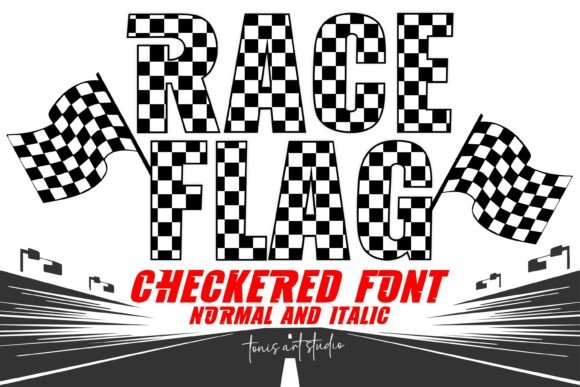
Race Flag Checkered: Speed and Style for Your Designs
Understanding the Race Flag Typeface
Let's be honest: most fonts just sit there. Race Flag Checkered, on the other hand, feels like it's moving before you even type a word. This is a display font at its core, built specifically for impact, not for writing long paragraphs of body text. It draws its DNA directly from motorsport culture, specifically the iconic checkered flag used to signal the end of a race.
The defining feature is exactly what you expect: a high-contrast, checkered fill pattern integrated into the letterforms. It’s not just a standard bold font with a texture slapped on top; the letter strokes are designed to accommodate the pattern without losing the structural integrity of the alphabet. The visual weight is heavy, making it an excellent choice for headers where you need to command immediate attention. It carries a distinct personality—aggressive, energetic, and competitive—making it a powerful tool in your collection of design assets.
Visual Dynamics and the Two-Style Family
One of the practical strengths of this typeface is that it comes as a two-style family: Normal and Italic. The Normal style is upright and grounded, perfect for establishing a strong baseline in your layout. It works well for static applications like signage or stable logo elements.
However, the Italic style is where the kinetic energy really shines. By slanting the letters, the checkered pattern takes on a sense of velocity. It mimics the blur of motion, making it look like the text is actually accelerating. This is particularly useful in editorial design or social media graphics where you want to imply action or excitement. Whether you are working on web design for a motorsport blog or creating graphics for a local racing event, the interplay between these two styles allows you to create a visual hierarchy that suggests both stability (Normal) and action (Italic).
Strategic Applications: Where to Use Race Flag
As a designer or business owner, knowing when to use a premium font like this is just as important as having it. Because Race Flag Checkered is a highly stylized creative font, it excels in specific contexts where thematic reinforcement is the goal.
Here are some practical scenarios where this typeface delivers maximum value:
- Apparel and Merchandise: The texture translates beautifully to fabric. Think T-shirt graphics, hoodies, or racing jerseys. The bold outline holds up well in screen printing and embroidery.
- Event Branding: If you are designing for a charity run, a go-kart tournament, or a car show, this font instantly sets the theme. Use it for banners, posters, and entry tickets.
- Maker Projects: For those using Cricut or Silhouette machines, the distinct edges of the letters make for interesting vinyl cuts. It’s excellent for car decals, pit stop signs, or garage wall art.
- Gaming and Esports: The aggressive styling fits perfectly within the gaming niche, particularly for racing simulators or competitive team logos.
It is less suited for corporate reports or legal documents, obviously, but for any project requiring a "high-octane" aesthetic, it is a top contender.
Pairing and Typography Strategy
Using a decorative font effectively often requires a balancing act. Since Race Flag Checkered is visually dense, pairing it with the wrong typeface can result in a cluttered design. The goal is to let the checkered texture be the star while supporting it with something legible for secondary information.
When selecting a font pairing, look for contrast in weight and simplicity. A clean sans serif font usually works best here. Because Race Flag has a lot of texture, you want your secondary text to be smooth and simple. Avoid pairing it with a script font or a highly detailed serif font, as the visual noise will compete for attention.
For example, if you are creating a poster for a race day, you might use Race Flag Italic for the headline "Race Day" and a clean, geometric sans-serif like Montserrat or Open Sans for the date and location details. This ensures your brand identity remains readable while still conveying the excitement of the event. In packaging design, this approach helps the product stand out on the shelf while keeping the ingredient list or instructions clear.
Readability and Technical Considerations
While Race Flag is a fantastic display font, you have to respect its limitations regarding readability. The checkered pattern, while visually striking, can reduce legibility at very small sizes or in long strings of text. If the text gets too small, the squares in the pattern may blend together or look like visual noise rather than distinct characters.
Therefore, this is not a modern typography solution for your blog body text or detailed product descriptions. It is designed for headers, titles, logos, and short, punchy statements. When testing your designs, always print a proof or view it at 100% zoom on a mobile device. Check that the letters remain distinct. If the text needs to be read quickly from a distance—such as a road sign—ensure the contrast between the black and white checkers is high enough to pop.
Licensing and Commercial Use
For entrepreneurs and small business owners, the legal aspect of fonts is a critical detail that often gets overlooked. Race Flag Checkered is generally distributed as a commercial font, meaning it is licensed for use in projects that generate revenue. However, "commercial use" can mean different things depending on the foundry or marketplace where you purchased it.
Before you finalize a logo design for a client or launch a line of merchandise, review the End User License Agreement (EULA). Key things to look for include:
- Print Volume: Some licenses limit the number of physical prints (like T-shirts or mugs) you can produce. If you plan to sell high volumes of merchandise, ensure your license covers that scale.
- Digital Embedding: If you are using the font in web design or a mobile app, check if the license permits web-font conversion or digital embedding.
- Logo Usage: Most standard licenses allow for logo creation, but it is always worth verifying that the font can be converted to outlines (paths) for client handover.
Treating your typography as professional assets ensures that your brand identity