Children’s Scribbles: Your Go-To Creative Font for Playful Projects
There’s a specific kind of energy in a child’s drawing—unfiltered, spontaneous, and full of character. Capturing that feeling in a professional design can be a challenge. You want the whimsy without the chaos, the personality without sacrificing clarity. This is the precise space that the Children’s Scribbles font occupies. It’s not just a handwritten font; it’s a design asset that brings the authentic, joyful spirit of a child’s world into your projects.
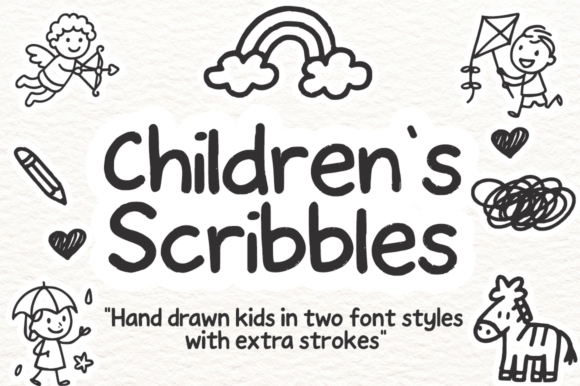
At its core, Children’s Scribbles is a display font built around the charming, imperfect lines of a young learner’s handwriting. The letterforms are round, light, and intentionally irregular, mimicking the way a child carefully shapes their first letters. What truly sets it apart are the integrated doodle elements—tiny hearts, stars, clouds, and playful figures that are woven into the character set. These aren’t afterthoughts; they’re part of the font’s DNA, allowing you to add decorative touches seamlessly as you type.
More Than Just Cute Letters: Understanding Its Design DNA
When evaluating a creative font like this, it’s helpful to look beyond the surface charm. The strength of Children’s Scribbles lies in its careful balance. The x-height is generous, which aids legibility even at smaller sizes, a crucial consideration for anything from a classroom poster to a mobile app interface. The baseline is intentionally wobbly, but the overall rhythm remains consistent, ensuring words and sentences flow naturally without becoming disjointed.
Think of it as a specialized tool in your modern typography kit. It’s not a replacement for a clean sans serif font or a formal serif font for body text. Instead, it excels as a headline, accent, or feature font. Its personality is strongest when used for short bursts of text—titles, subheadings, pull quotes, or call-to-action buttons where you want to inject immediate warmth and approachability.
Where This Font Truly Shines: Practical Applications
The real value of any premium font is measured by its versatility. Children’s Scribbles finds its home across a surprisingly broad range of projects, each time delivering a distinct emotional impact.
- Educational & Classroom Materials: This is its most natural habitat. For kindergarten and preschool resources like worksheets, flashcards, and learning posters, the font immediately creates a welcoming, fun learning environment. It reduces the intimidation factor of new letters and numbers for young learners.
- Children’s Branding & Packaging: Entrepreneurs creating products for kids—from snack brands to toy lines—can use this font in their logo design or packaging design to signal playfulness and trust. It works beautifully on product labels, boxes, and retail signage.
- Publishing & Editorial Design: In children’s books, it can be used for chapter titles or character dialogue to enhance the narrative voice. For editorial design in family-focused magazines or blogs, it adds a relatable, friendly touch to headers and sidebars.
- Events & Personal Projects: Birthday invitations, party decor, nursery room art, and scrapbooking are elevated by its whimsical style. For crafters, it’s perfect for creating unique stickers, iron-on designs, and personalized stationery.
- Digital & Social Media: Don’t limit it to print. As part of a font pairing strategy, it can bring life to social media graphics, website banners for family-oriented businesses, or email newsletters. Its playful vibe boosts engagement in a crowded digital space.
Integrating Children’s Scribbles into Your Workflow
Adopting a new typeface requires more than just liking its look. Here’s how to approach Children’s Scribbles strategically.
Evaluate the Fit: Does your project’s tone need a boost of warmth and informality? If you’re designing for a serious financial institution, this isn’t your font. But if your audience is families, educators, or anyone targeting the children’s market, it’s a powerful tool. Consider the brand identity you’re building—is it nurturing, educational, playful, or creative?
Master the Font Pairing: A handwritten font like this needs a stable partner. For visual hierarchy, pair it with a simple, geometric sans serif font for body copy. The contrast allows the display font to stand out without causing visual clutter. Test combinations carefully; the goal is harmony, not competition. For instance, a clean sans serif like Montserrat or Lato can provide excellent balance.
Explore the Full Character Set: Don’t just type A-Z. Open the glyph panel in your design software. Children’s Scribbles often includes multiple versions of letters, alternates, and the full set of doodle ornaments. Using these variations prevents repetition and adds a more organic, handcrafted feel to your layouts.
Consider Readability First: While legible for a display font, it’s not designed for long paragraphs. Use it for headlines, short phrases, and isolated words. Always conduct a print test or view it at 100% on screen to ensure clarity at your intended size. For web design, check rendering across different browsers and devices.
Understand the Licensing: As a commercial font, ensure you purchase the correct license for your use. Most premium fonts offer different tiers for desktop, web, and app use. If you’re using it for a client’s logo design or a product for sale, verify the license covers that application to avoid legal issues down the line.
A Final Thought on Authenticity
In a landscape saturated with sleek, minimalist typography, Children’s Scribbles offers a return to something genuine. It doesn’t try to be perfect; it celebrates the charming imperfections of learning and play. For designers, marketers, and creators, it’s a tool to connect with an audience on an emotional level, to evoke nostalgia, and to communicate a message with a smile. When used thoughtfully, it doesn’t just decorate a page—it tells a story and becomes a memorable part of your project’s brand identity.